

Washington's Self-Inflicted "Energy Burden"
How a “climate crisis” echo chamber and detached-from-reality energy strategy are rapidly driving up the cost of electricity, natural gas, and gasoline in once energy-dominant Washington State

Hydropower supplied 5.6% of U.S. electricity in 2024. In Washington State which leads the nation in hydro, the number is more than ten times this level, with about 60% of annual electricity supply coming from hydro.
Consequently, carbon-dioxide (CO₂) emissions from Washington’s electricity sector have recently averaged 0.7% of the U.S. annual inventory. Additionally, on a per capita basis, total energy sector CO₂ emissions for the last 25 years attributable to each Washington citizen have only been 50% of the U.S. average.
And on top of being a “clean energy” leader, Washington has for decades enjoyed some of the lowest retail electricity prices in the nation, by far.
Washington’s top-tier electricity supply status and its long-coveted economic development advantage made possible by uniquely low-cost hydropower remind me of when I took over as general manager of an exceptionally well-run utility. As he handed over the reins, the outgoing GM shared the same advice his predecessor had given him: “Good luck—and don’t screw it up.”
If only Washington State legislators had taken this simple advice.
Snatching Defeat from the Jaws of Victory
Enter Washington’s Clean Energy Transformation Act (CETA) which became law in 2019. Built on the “climate crisis” narrative evangelized by former three-term Governor Jay Inslee, CETA requires Washington utilities supply 100% carbon-free electricity to their customers by 2045. It just wasn’t enough that Washington’s electricity-sector fuel mix was already 70% non-CO₂ emitting.
And in their climb to the mountaintop of environmental virtue, utilities are required to reach 80% carbon-free power by 2030 and to pay penance for the remaining “dirty” 20% through purchases of renewable energy certificates or other state-approved investments signaling sufficient devotion to ridding the planet of life-giving, odorless, tasteless, and invisible CO₂. Now officially rebranded “carbon pollution” as illustrated in the following graphic.
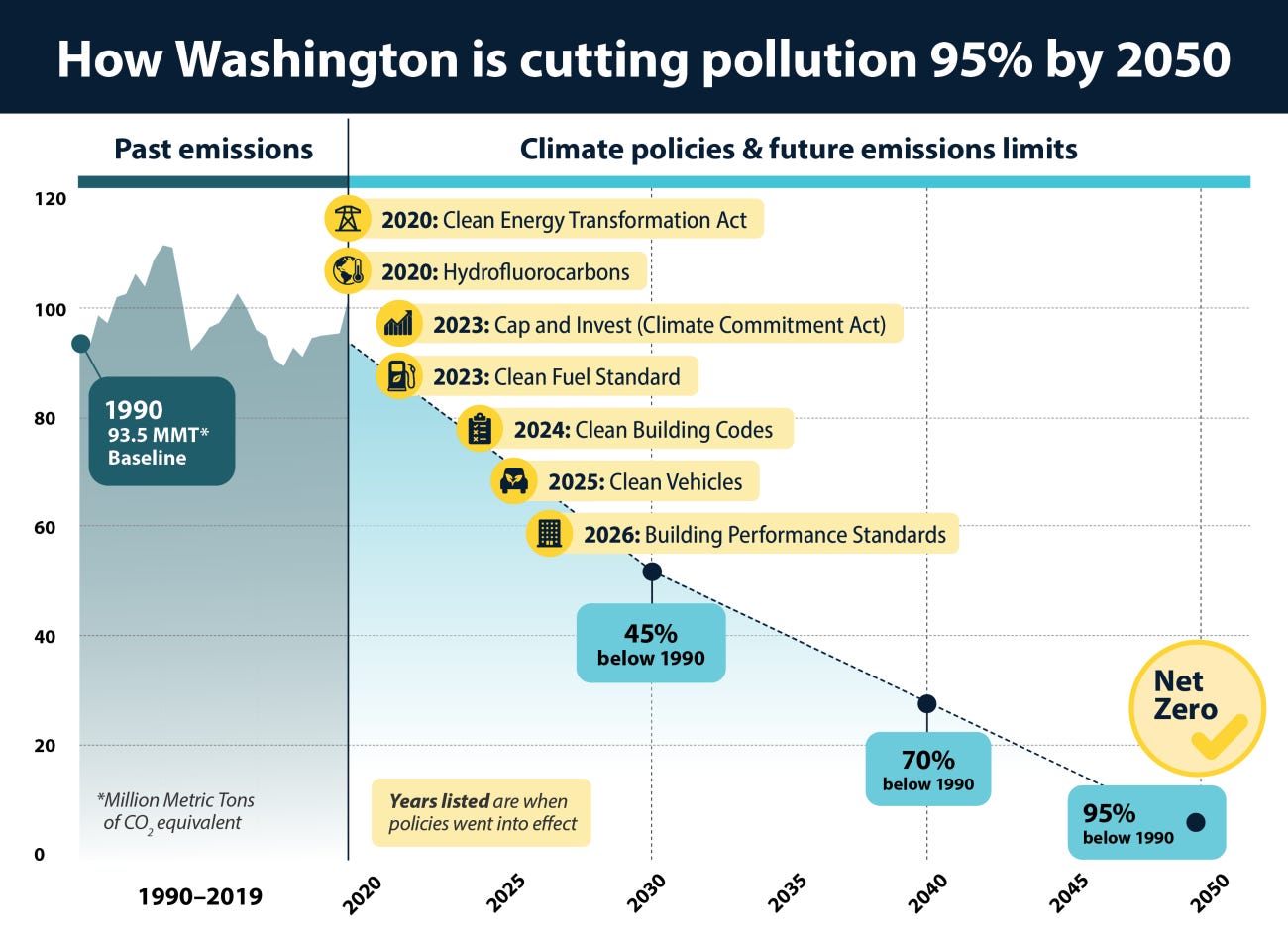
Yes, CO₂ exerts a warming influence on global climate. But calling it pollution and portraying it as a black, sooty substance (carbon) with nothing but negative effects, is at best, propaganda-adjacent. Afterall, didn’t we learn in elementary school that CO₂ is plant food?
No matter. Whether it’s global greening, protection from extreme cold and heat, or increased quality of life or life expectancy, when it comes to the seven climate policies adopted by Washington state there can be no upside to CO₂ or the hydrocarbons (fossil fuels) from which it comes. We must set aside comprehensive costs versus benefits, and cradle-to-grave ecological impacts analysis. There is only “clean” and “dirty” energy — it’s just that simple.
And while “following the science” is claimed to be a pillar of Washington’s energy policies, one important way to keep things simple is to ignore inconvenient realities and by all means never put Washington CO₂ emissions in a national or global context.
Evidence of this coordinated navel-gazing is easy to find in Washington’s officially adopted Clean Energy Strategy and in the Findings sections of both CETA and the Climate Commitment Act (CCA), which, beginning in January 2023 imposed a price on CO₂ emissions; effectively a carbon tax.
In each case, the language amplifies state-approved climate-crisis talking points and advances a carefully curated set of indisputable “facts” designed to rally fellow climate crusaders while setting the stage for a planetary rescue mission, and promises of a utopian future in which everyone’s interests are served. We will abandon evil fossil fuels, electrify everything; and of course, it will all be affordable.
But before we talk economics, let’s do something no Washington clean-energy law, report, or taxpayer-funded grant program ever does: put Washington’s CO₂ emissions in perspective.
Washington CO₂ Emissions Reality Check
According to U.S. Energy Information Administration estimates, for the past 20 years energy sector CO₂ emissions in Washington have been relatively flat averaging 76 million metric tons (MMT).
While millions of tons of “carbon pollution” may sound alarming, placing Washington’s emissions in a global context tells a very different story. On the same scale used for global totals, Washington’s annual emissions amount to roughly 0.076 billion tons, compared with 38.6 billion tons of global emissions in 2024, as shown in the graphic below.
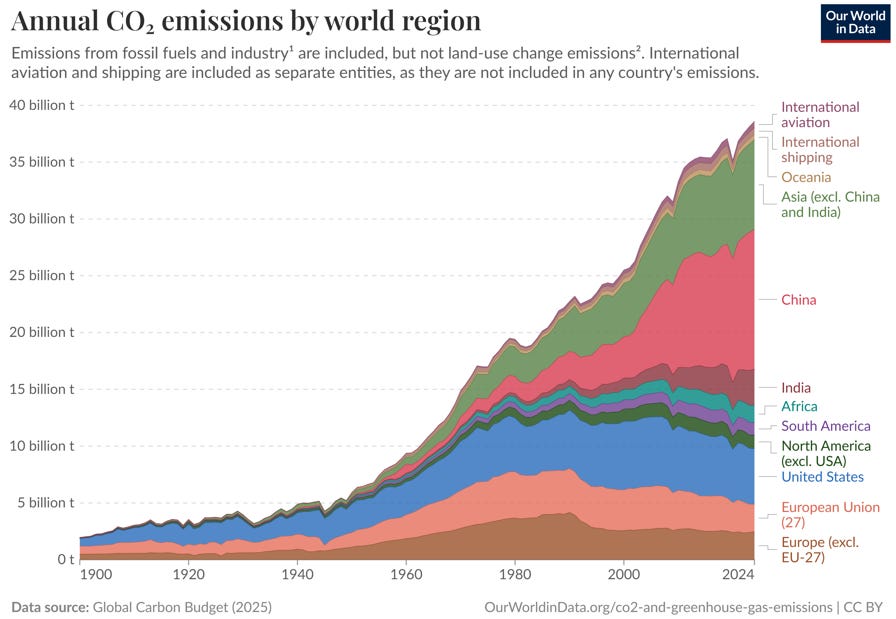
Perhaps unsurprisingly, Washington emissions register two decimal places to the right of the global total and are barely perceivable in the grand scheme of things. What is perceivable however is the relentless and steady increase in global emissions. And if you look closely, you will see that U.S. emissions in recent years are decreasing and bucking the global trend.
A closer look at the data reveals that U.S. emissions peaked in 2007 at 6.12 billion tons and have decreased 20% since then to 4.9 billion tons in 2024. Furthermore, over 72% of the 1.22-billion-ton reduction was the result of fuel switching in the electricity sector from coal to natural gas. Yes, that’s correct: a fossil fuel has been the single largest contributor to “cleaning up” the U.S. energy sector to date.
Which raises an obvious question: if emissions in the U.S. as well as those in the European Union are falling, why do global emissions keep rising? The short answer is that prosperous Western civilizations are not convincing poor people to stay poor, despite the “good example” they claim to be setting with their war on CO₂; and their growing willingness to commit economic suicide.
Developing countries on the other hand are prioritizing increased human flourishing through rapid development of abundant, affordable and reliable energy, primarily based on hydrocarbons. Nowhere is the contrast clearer than in China, which by many accounts has built nearly 300 coal-fired power plants since 2019.
As data from the previous graphic reveals, China’s annual energy sector emissions in 2024 were 12.29 billion tons representing an eye popping 76% increase since the U.S. decline began in 2007.
Bringing the focus back to Washington State. Just since the passage of CETA in 2019, annual CO₂ emissions in the developing world represented by Asia, China and India have increased by 2.47 billion tons; an incremental amount which is more than 32 times Washington’s entire energy sector. Baseline the comparison to 2007, and the incremental change in the developing world’s emissions grows to 122 times Washington’s total emissions.
Yes, I know, it’s unfair to compare Washington’s emissions attributable to a population of roughly eight million to that of nations representing billions. But I’m not the one crowing about how the state is “leading on climate” or promising our bold policies will beat back “the worst impacts of climate change”.
Further, I didn’t write the Findings section of Washington’s CETA which states:
With our wealth of carbon-free hydropower, Washington has some of the cleanest electricity in the United States. But electricity remains a large source of emissions in our state. (emphasis added)
I suppose when you live daily with existential guilt over your carbon footprint, large comes to mean something different.
To be clear, Washington’s electricity sector annual emissions have averaged 0.011 billion tons for the past decade, and as noted earlier, account for less than 0.7% of U.S. electricity sector emissions. Neither figure strikes me as large.
The Data is In
What the data clearly shows is that Washington State could fall off the planet tomorrow and it would make virtually no difference to the future concentration of CO₂ in the global atmosphere, which today stands at about 0.042%; up from an estimated 0.028% prior to the Industrial Revolution.
If in fact CO₂ emissions are a global climate-catastrophe control knob as claimed by Jay Inslee and the majority of Washington legislators who crafted CETA and CCA language, what the world needs most is massively more nuclear power, not another “‘good example” set by a state with a carbon-free electricity mandate built on a foundation of hydropower that doesn’t scale anywhere else in the U.S., or most of the world for that matter.
To be fair, CETA does recognize nuclear power as a qualifying non-emitting source of electricity, but it receives scant attention in Washington’s Energy Strategy. Instead, the strategy goes all-in on wind and solar projects largely built in other states, paired with a vision of importing 43% of Washington’s electricity by 2050 over vast new high-voltage interstate transmission lines. Experience shows such lines can take 15 to 20 years, or more, to plan, permit, and construct. And last time I checked, we just ended 2025, and CETA’s mandate for 100% carbon-free electricity takes effect in 2045.
Washington legislators need to take a breath, stop with the carbon-free moralizing, and get outside the Olympia climate-crisis echo chamber. In addition to engaging more with experienced utility professionals who are living with Washington’s energy policies every day, I recommend reading some alternative reports and studies from highly credible centrists like Roger Pielke Jr., who has warned that symbolic targets like Net Zero 2050 can justify policies that sacrifice human welfare for unattainable goals. Pielke was quoted as saying:
“The greatest risk to climate policy is that it promises what it cannot deliver—and then imposes enormous costs on society when it fails.”
How about listening to Washington’s own Bill Gates, who sparked significant debate with his October 28, 2025, blog post “Three Tough Truths About Climate.”
In it, Gates argues that while climate change remains a serious challenge, it “will not lead to humanity’s demise,” and that policy responses must extend beyond emissions reductions to include improving quality of life, fostering innovation, and strengthening adaptation.
And the early results underscore that point. CETA and CCA have barely been implemented, yet energy costs across the board are already climbing steeply, raising serious questions about the balance between climate goals and affordability.
Rising Natural Gas Prices
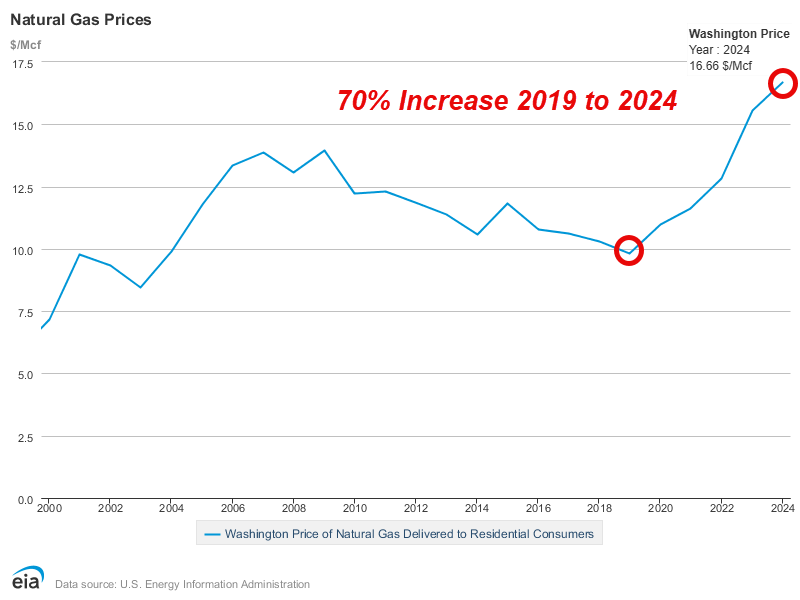
After reaching a 15-year low of $9.82 per Mcf in 2019, Washington’s residential natural gas prices ended 2024 at $16.66, representing a nearly 70% increase in 5 years.
Taxing CO₂ emissions from natural gas under the Climate Commitment Act is also driving up electricity rates, including for utilities with hydro-dominated power supply portfolios.
Water availability for hydroelectric generation can vary significantly from year to year, which means dependable natural gas plants are essential as a hedge against blackout risks and extreme price volatility during low-water conditions. I plan to write more about this in a future post.
Rising Electricity Prices
Despite constant assurances that rapidly implementing CETA’s 100% carbon-free electricity mandate, while attempting to tax fossil fuels out of existence will be affordable, there is little evidence this holds true globally, nationally, or even in hydro-dominated Washington State.
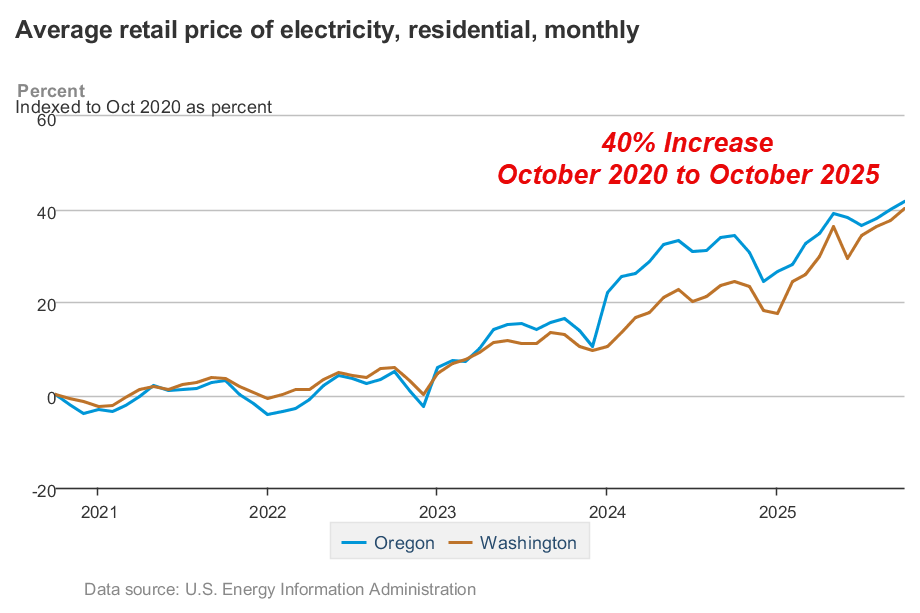
To further illustrate the point that carbon-free constraints are a guaranteed cost-increase driver, the following graph includes Oregon, which adopted a 100% carbon-free mandate for investor-owned utilities by 2040.
While both Washington and Oregon residential electricity rates are still 28% and 11% lower than the U.S. average respectively, the trend is changing, and not in a good direction. What the graph shows is that residential electricity rates in both Washington and Oregon when indexed to rates in October 2020 have risen by more than 40%.
And no, recent electricity rate increases in Washington and Oregon were not caused by Trump’s Big Beautiful Bill or Big Tech’s data centers. They are primarily the result of investor-owned utilities scrambling to acquire scarce wind, solar and battery power to meet carbon-free mandates while keeping the grid reliable. More on this in a future post as well.
As I detailed in my last post, real-world experience over the past 20 years shows that retail electricity rates tend to rise by roughly 5 cents per kilowatt-hour (kWh) for every 10% increase in wind and solar penetration on the power grid.
Washington’s electricity fuel mix is about 12% wind and solar (mostly wind) today, and average residential rates are about 12 cents per kWh. So increasing wind and solar to just 22% can be expected to raise average residential rates by another 40% on top of what has already occurred.
Rising Gasoline Prices
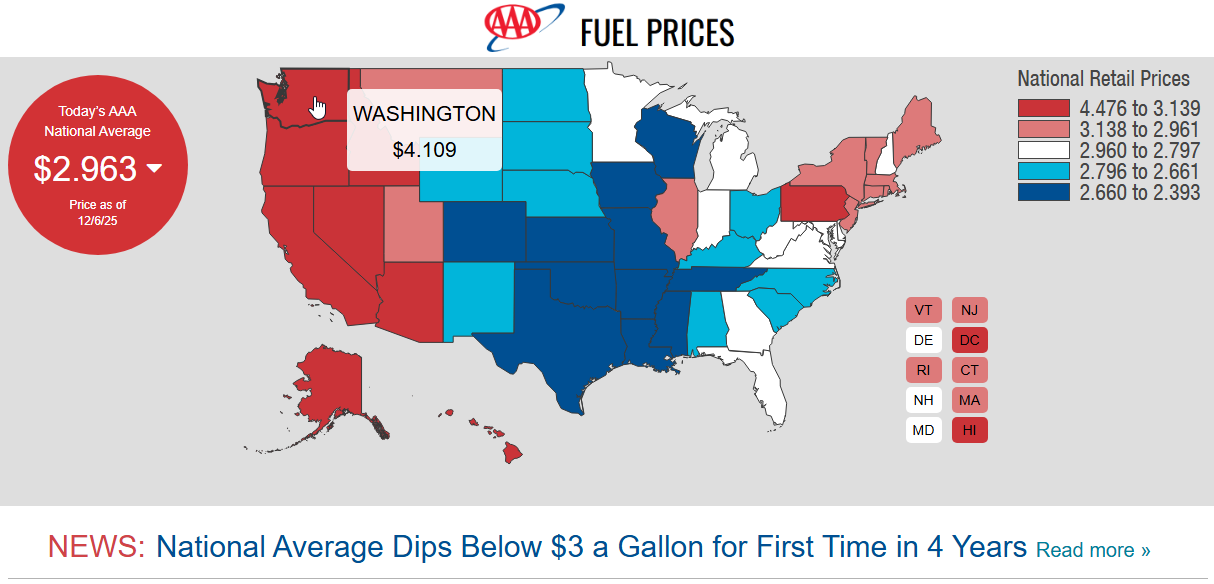
If you’re wondering how high Washington lawmakers are willing to let natural gas and electricity prices rise in the name of fighting the “climate crisis,” just look at gasoline prices. By December 2025, they had been driven to nearly the highest level in the nation under the strong influence of the state’s Climate Commitment Act.
Conclusions
Washington’s CETA language includes energy burden as a defined term, and mandates all electric utilities search out the afflicted souls who are paying too high a share of annual household income on home energy bills, so other utility rate payers can subsidize them through state-forced expansion of low-income assistance programs.
Yes, you heard me right: Washington’s CETA is being used as an instrument of wealth redistribution.
It is a sad irony that Washington energy policies, which proclaim the greatest concern for underrepresented and historically marginalized communities and champion “energy justice,” are the very policies now rapidly increasing the cost of living and placing the heaviest burden on those least able to afford it.
Demonizing fossil fuels and taxing them out of existence sit at the core of the state’s current energy policies. And I fear if we don’t moderate them soon, we could be entering an era of lost economic development opportunities, rising living costs, and an outflow of businesses and residents.
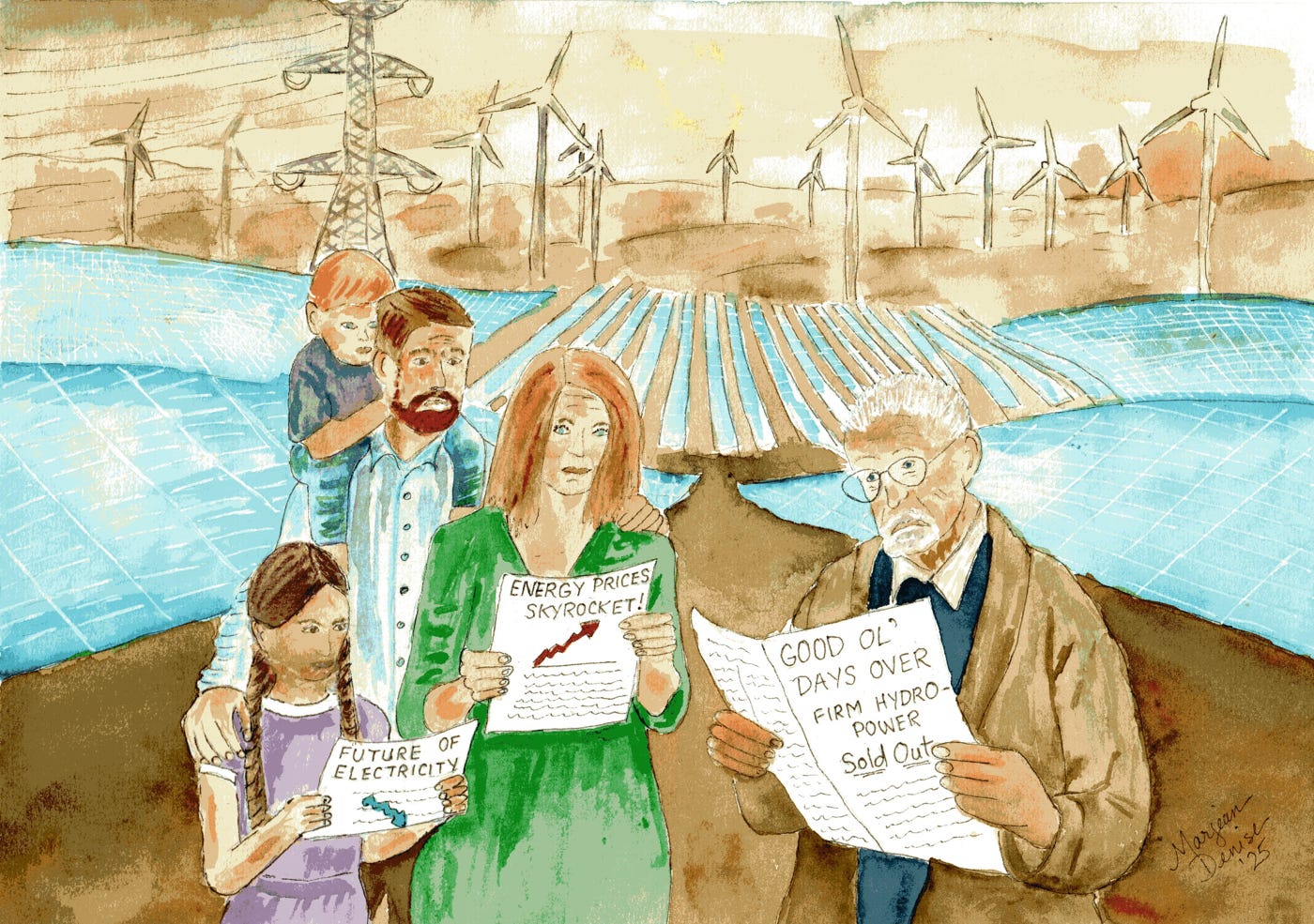
And if legislators think high prices make for an unruly electorate, imagine how unhappy voters will be if they are paying significantly more for electricity and the lights go out during a deep freeze or heat wave.
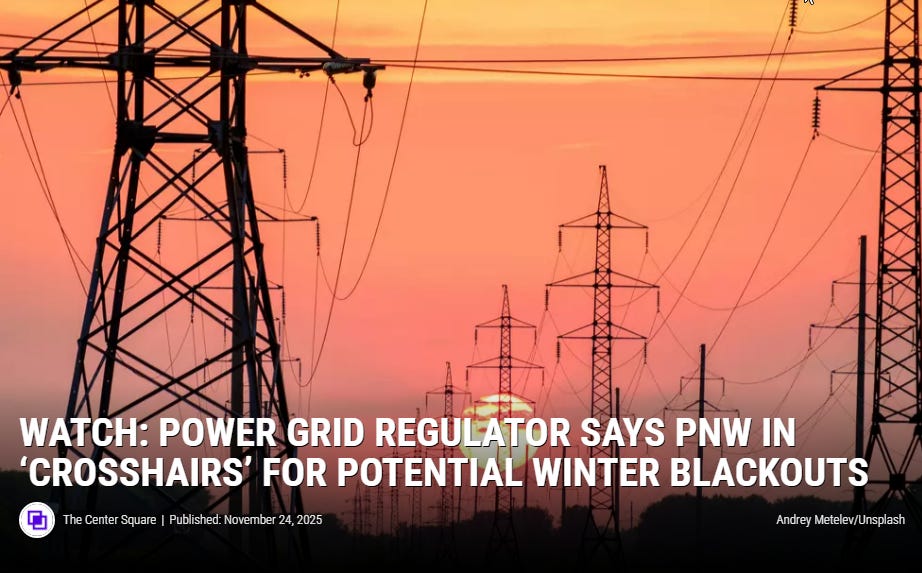
Wake up Washingtonians! As the following article warns, we are already walking the northwest power grid closer and closer to a blackout cliff under the constraints of draconian carbon-free electricity mandates in Washington and Oregon, and attempts to break the backs of the natural gas and petroleum industries.
The 2026 Washington State legislative session begins on Monday, January 12, and lawmakers need to hear loud and clear that we do not accept the energy burden they are imposing on households and businesses across the state.
Links to Substack posts like mine are easy to text, email or share on social media, and mine are free. So have at it, and stay tuned for more in the coming weeks.
And the same people touting carbon-free hydropower are the same people pushing for breaching dams (while also pushing for covering the east side of the state in windmills and solar panels).
The Adequacy Standard has moved into unacceptable territory, the probability of blackouts is increasing. Very cold & very hot power demand combined with scant water years and transmission/pipeline bottlenecks are real world events that can move the grid into demand exceeds supply.
nwcouncil.org "The Ninth Plan comes at a critical point with the region facing significant load growth and a shifting resource mix. This plan will put forward robust recommendations for how to cost-effectively meet those needs over the next twenty years....
The Council does this leveraging its new, innovative method to protecting the Northwest power grid’s resource adequacy. We now use multiple metrics to plan for resource adequacy.
Many electricity grids in the U.S. still use a one-day-in-10-years adequacy standard. While that gauges the potential frequency of an energy shortfall, it doesn’t provide information about its magnitude or duration, or the season in which it will occur. Under a one-day-in-10-years standard, we were concerned that a major energy shortfall could masquerade itself and be permitted to occur."
What is the cost of a "Blackout"?